In the early days of cybersecurity, most attacks had a familiar goal: steal data, extort money, or disrupt networks. Malware might slow down a system or lock files behind ransomware, but the damage almost always lived inside the digital world.
Then something appeared that changed everything.
In 2010, security researchers analysing a strange piece of malware discovered something unprecedented. Hidden inside the code was a highly sophisticated weapon designed not just to infect computers, but to physically destroy industrial equipment.
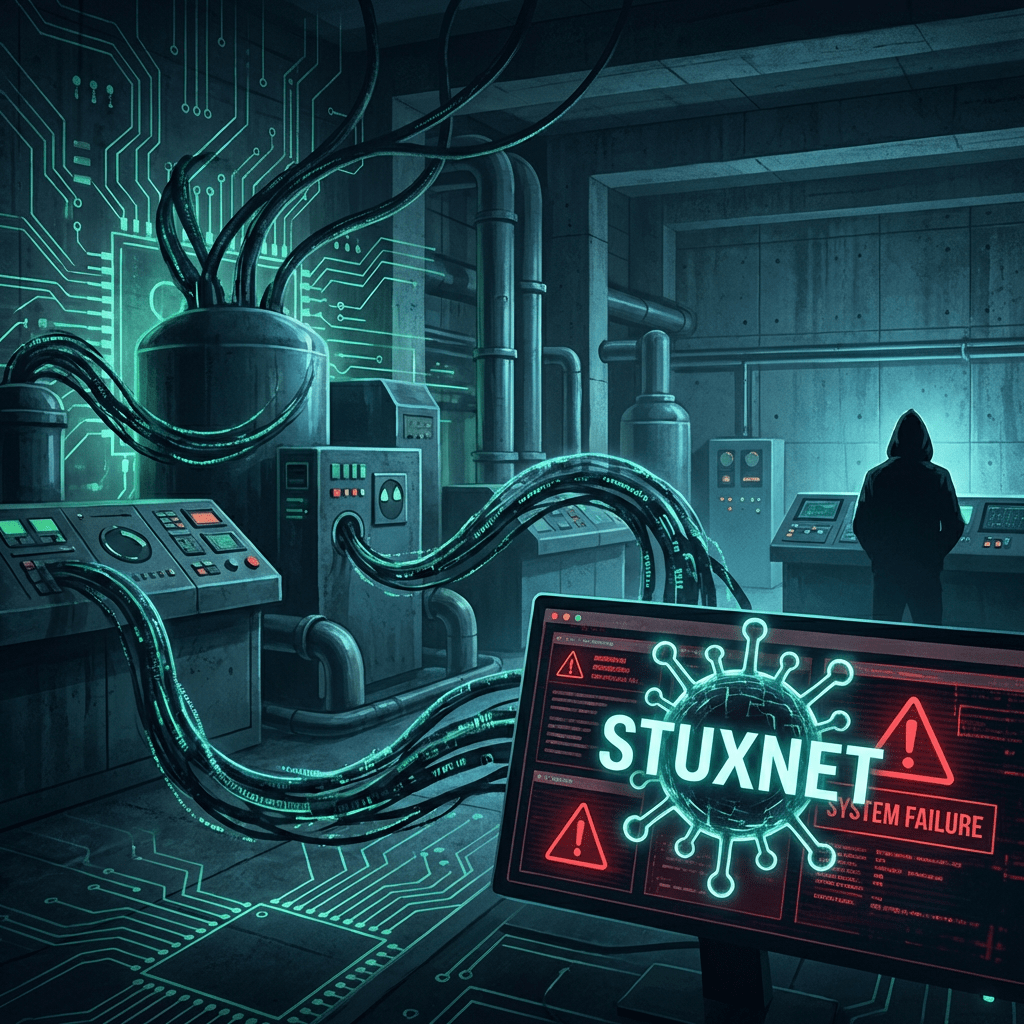
That malware would become known as Stuxnet, and it marked the moment cyber warfare crossed from theory into reality.
A Worm That Shouldn’t Exist
The story began quietly.
In June 2010, the Belarusian security company VirusBlokAda was investigating computers in Iran that were repeatedly crashing. What they found looked at first like another Windows worm spreading through USB drives.
But as researchers dug deeper, they realised this malware was unlike anything they had seen before.
Stuxnet exploited multiple zero-day vulnerabilities in Microsoft Windows, something extremely rare at the time. Even more unusual, the malware used legitimate digital certificates stolen from hardware companies to appear trustworthy.
This wasn’t the work of a typical cybercriminal.
The codebase was enormous, estimated at over 500,000 lines, and it demonstrated a level of precision that suggested years of development.
But the real surprise came when analysts discovered what the malware was actually targeting.
The Real Target: Iran’s Nuclear Programme
Stuxnet wasn’t built to spread widely.
Instead, it was hunting for a very specific type of system: industrial controllers made by Siemens, running software used to automate heavy machinery.
More specifically, Stuxnet targeted programmable logic controllers (PLCs) used in uranium enrichment facilities.
The destination was believed to be the Natanz Nuclear Facility in Iran.
Inside Natanz, thousands of delicate centrifuges spun at extremely high speeds to enrich uranium. These machines required precise control, tiny changes in speed could cause catastrophic mechanical failure.
And that was exactly what Stuxnet was designed to do.
A Masterclass in Stealth
Once inside the network, Stuxnet behaved with remarkable restraint.
If the malware didn’t find the exact industrial configuration it was looking for, it simply remained dormant. Most infected machines never experienced any damage at all.
But when the right target appeared, Stuxnet sprang into action.
The malware secretly modified the instructions sent to the centrifuge controllers. It would periodically force the machines to spin far faster than their safe operating speeds, then abruptly slow them down again.
These fluctuations placed enormous stress on the delicate components.
At the same time, Stuxnet did something particularly clever: it fed fake data back to monitoring systems, making everything appear normal to engineers.
From the control room, the centrifuges looked perfectly healthy.
On the factory floor, they were slowly tearing themselves apart.
The First True Cyber Weapon
By the time Stuxnet was discovered, the damage had already been done.
Reports suggested that roughly 1,000 centrifuges at Natanz had been destroyed or taken offline. The attack significantly delayed Iran’s nuclear enrichment programme.
But the most profound impact wasn’t the equipment it destroyed.
It was the precedent it set.
Stuxnet proved that malware could jump the boundary between digital systems and the physical world. Software could now sabotage infrastructure, machinery, and industrial processes.
The implications were enormous.
Power grids, water treatment plants, factories, and transportation systems all relied on the same kinds of industrial control technology.
Stuxnet demonstrated that they could be turned against themselves.
Who Was Behind It?
No government has ever officially claimed responsibility for Stuxnet.
However, most cybersecurity researchers and intelligence analysts believe the attack was a joint operation between the United States and Israel.
Investigative reporting by The New York Times linked the malware to a covert programme reportedly called Operation Olympic Games, initiated during the administrations of George W. Bush and later expanded under Barack Obama.
The goal was to slow Iran’s nuclear progress without resorting to a conventional military strike.
If true, Stuxnet would represent the first publicly known cyber weapon deployed by nation states to cause physical destruction.
The Ripple Effects
Although Stuxnet was built for a specific mission, its discovery had global consequences.
Once the malware was uncovered, researchers around the world began analysing its techniques. The code revealed new attack methods against industrial systems that many organisations had never considered.
In the years that followed, other attacks would begin targeting critical infrastructure, sometimes with devastating results.
Stuxnet had opened a door.
And it could not be closed again.
Lessons from Stuxnet
Even today, the attack remains one of the most studied incidents in cybersecurity history.
It highlighted several key lessons:
1. Industrial systems are vulnerable
Operational technology was never designed with modern cyber threats in mind.
2. Air-gapped networks are not invincible
Stuxnet likely entered Natanz through infected USB drives, proving isolated networks can still be compromised.
3. Cyber warfare is real
Nation states are willing and capable of developing offensive cyber weapons.
4. Cyber attacks can cause physical damage
Digital intrusions can now have real-world consequences.
Timeline of the Attack
2005–2007 – Development of Stuxnet reportedly begins.
2009 – Early versions begin spreading through targeted networks.
June 2010 – Stuxnet is discovered by VirusBlokAda.
2010 – Researchers reveal the malware targets Siemens industrial systems.
2012 onward – Evidence increasingly links the operation to US and Israeli intelligence.
Final Thoughts
Stuxnet wasn’t just another piece of malware.
It was a glimpse into the future of conflict.
In a world increasingly dependent on connected systems, the line between cyber operations and physical warfare has become dangerously thin. The Stuxnet attack showed that with enough sophistication, a few lines of code could achieve what once required bombs or missiles.
And once that capability existed, it was only a matter of time before others tried to replicate it.
Sources & Further Reading
Symantec Security Response – W32.Stuxnet Dossier
https://www.symantec.com/content/en/us/enterprise/media/security_response/whitepapers/w32_stuxnet_dossier.pdf
Langner Communications – To Kill a Centrifuge: A Technical Analysis of Stuxnet
https://www.langner.com/wp-content/uploads/2017/03/to-kill-a-centrifuge.pdf
Kaspersky Lab – Stuxnet Under the Microscope
https://securelist.com/stuxnet-under-the-microscope/
International Atomic Energy Agency (IAEA) – Reports on centrifuge disruptions at the Natanz facility
https://www.iaea.org
The New York Times – Obama Ordered Wave of Cyberattacks Against Iran (Olympic Games reporting)
https://www.nytimes.com/2012/06/01/world/middleeast/obama-ordered-wave-of-cyberattacks-against-iran.html
Ralph Langner – Stuxnet: Dissecting a Cyberwarfare Weapon
https://www.langner.com/stuxnet
MIT Technology Review – The Real Story of Stuxnet
https://www.technologyreview.com
 Chronicles of Compromise
Leave a comment