Prologue: A Quiet Night in St. Paul
Late 2005. St. Paul, Minnesota.
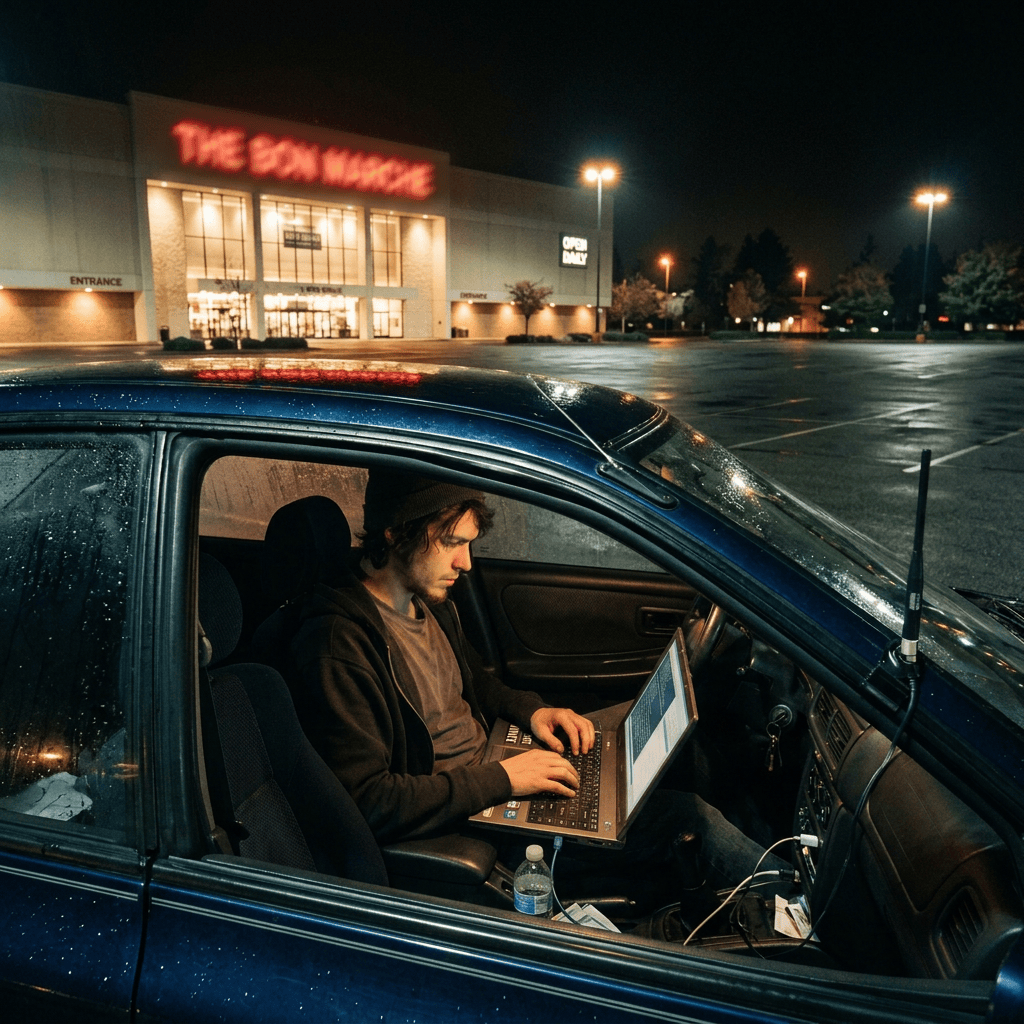
A Marshalls store sits at the edge of a strip mall parking lot, closed for the night. Inside, the registers are dark. Outside, in the lot, a car idles, nothing unusual, just someone checking their phone, maybe waiting for a friend.
Except the laptop on the passenger seat isn’t idle at all.
It’s listening.
Somewhere in that store, a wireless network is broadcasting, the same way thousands of retail wireless networks were in 2005, quietly, routinely, and with far weaker locks on the door than anyone in Framingham, Massachusetts, where TJX Companies kept its headquarters, had any reason to suspect.
The laptop finds the signal. It finds the lock. And the lock, it turns out, is barely a lock at all.
Nobody working at that Marshalls that night knew it. Nobody at TJX’s head office knew it. It would be well over a year before anyone did.
“It’s been all over the world,” Bruce Spitzer, spokesman for the Massachusetts Bankers Association, would later say of the fraud that followed. “It’s the downstream transactions we’ve been hearing about.”
The invasion had already begun.
Part 1: The Invisible Invasion
The technique the intruders used has a name that sounds almost quaint now: wardriving, driving around with a laptop, scanning for wireless networks, and testing which ones are weakly defended. Think of it as someone walking down a street, quietly checking every car door to see which ones were left unlocked.
Along Route 1 near Miami, and later outside a Marshalls store in St. Paul, Minnesota, a hacking crew found their unlocked doors. The wireless networks inside these stores were still protected by WEP encryption, a security standard that, by 2005, was already known among researchers to be crackable in minutes with freely available tools. It was the digital equivalent of a bike lock made of plastic.
The initial break-in is believed to have happened around July 2005. From that first foothold, the intruders didn’t stop at the in-store network. They found a path leading deeper, from the wireless signal at a single retail location, all the way into TJX’s central systems for processing payment transactions, based in Massachusetts and the UK.
That path shouldn’t have existed. A properly walled-off network, one built with segmentation, the practice of keeping different parts of a network isolated from each other so a break-in in one place doesn’t become a break-in everywhere, would have stopped the intruders at the store. TJX’s network had no such walls.
Once inside, the attackers planted sniffer programs, malicious software that quietly copies data as it passes by, the way a wiretap copies a phone call without either party noticing. These sniffers were built to capture track data: the raw information stored on a card’s magnetic stripe, generated every time a customer swiped at the register.
There were no alarms. No flashing lights. Transactions kept processing normally. Customers kept swiping their cards at the register, completely unaware that a copy of their information was being quietly siphoned off and staged on servers the attackers controlled, waiting to be pulled out.
The breach ran undetected for roughly eighteen months.
Part 2: The Reckoning
Mid-December 2006.
TJX discovers the intrusion, not through some dramatic alarm, but through routine internal review, just weeks before Christmas, in the middle of the retailer’s busiest season. The company immediately calls in law enforcement: the U.S. Department of Justice, the Secret Service, and, because Canadian customers were affected too, the Royal Canadian Mounted Police.
For over a month, the public hears nothing. At the request of investigators, TJX keeps the breach confidential while the initial forensic work is done.
January 17, 2007. TJX goes public.
The company’s early statement is careful, almost clinical: “To date, TJX has been able to specifically identify a limited number of credit card and debit card holders whose information was removed from its system.” Behind that careful language was a number that would keep climbing for months, first into the tens of millions, and eventually to an estimated 94 million individuals and 45.7 million payment cards, with some court filings from banks putting the true number even higher, above 100 million.
For the banks that issued those cards, the reckoning arrived as a flood of phone calls and fraud alerts. Charles Bauer, chief technology officer at Middlesex Savings Bank in Natick, Massachusetts, learned that roughly 18,000 of the bank’s Visa debit cards had been compromised. The bank spent more than $100,000 reissuing around 8,900 still-active cards, and on top of that, absorbed roughly $13,000 in fraud losses from thieves using the stolen card data in purchases as far away as Italy, Australia, and Japan.
Middlesex Savings was one bank among hundreds. By late January 2007, 60 of the 205 banks in the Massachusetts Bankers Association alone had already been contacted by card networks about compromised accounts.
There was no ransom note. No countdown clock. No extortion demand landing in an inbox. This wasn’t that kind of breach, it was quieter and, in its own way, more corrosive: a slow bleed of stolen card numbers being sold and resold on underground forums, converted into fraudulent purchases and cash withdrawals an ocean away from the store where the card was first swiped.
Part 3: Behind the Curtain
The operation was led by a hacker who went by the handle “Segvec.” His real name was Albert Gonzalez, and his story is stranger than most cybercrime cases get.
Years before TJX, Gonzalez had avoided prosecution in an earlier credit card fraud case tied to the hacking forum Shadowcrew by agreeing to become a confidential informant for the U.S. Secret Service. According to court records, he was still nominally serving in that role, collecting a government paycheck for helping catch cybercriminals, while simultaneously masterminding the TJX intrusion and several others like it.
Gonzalez assembled a small, capable crew. Stephen Watt handled malware development. Damon Toey managed logistics and data handling. Christopher Scott assisted with network intrusions. Together, under the internal codename “Operation Get Rich or Die Tryin’,” they ran the same playbook again and again: wardrive for a weak wireless network, get inside, install a sniffer, harvest data, sell it on.
TJX was not their only victim. The same crew used variations of this approach against BJ’s Wholesale Club, OfficeMax, Boston Market, Barnes & Noble, Sports Authority, DSW, and Dave & Buster’s and, in an operation that would eventually surpass even TJX in scale, payment processor Heartland Payment Systems. Across his career, investigators tied Gonzalez to the theft of more than 170 million card numbers.
The motive here wasn’t ideology, and it wasn’t a nation-state chess move. It was money, old-fashioned financial crime, run at industrial scale, feeding a black market for stolen card data that stretched from Miami to Eastern Europe.
Gonzalez was arrested in May 2008. He pleaded guilty to charges including conspiracy, computer fraud, wire fraud, and aggravated identity theft. In March 2010, a federal judge sentenced him to 20 years in prison, at the time, the longest sentence ever handed down in the United States for a computer crime.
Part 4: How It Worked — The Technical Picture
A closer look at the mechanics behind the breach, in plain language.
Wardriving: Driving around with a laptop to scan for wireless networks and identify which ones are weakly secured, like walking a neighbourhood checking which houses left a window open.
WEP encryption: An early Wi-Fi security standard that, by the time of this breach, could be broken by attackers in minutes using widely available tools. It offered the appearance of a lock without much of the actual protection.
Lack of network segmentation: The single biggest structural failure in this story. A well-designed network keeps sensitive systems, like payment processing servers walled off from lower-security areas, like an in-store Wi-Fi network. TJX’s network had no such internal walls, so a foothold in one Marshalls store’s wireless signal opened a corridor all the way to the company’s core payment systems in Massachusetts and the UK.
Sniffer programs: Malicious software that silently copies data as it moves across a network, comparable to tapping a phone line. In this case, the sniffers were tuned to capture “track data,” the information stored on a card’s magnetic stripe during a swipe.
Staging servers: Rather than transmitting stolen data straight out of the network the moment it was captured, which risked detection, the attackers first stored it on compromised internal servers, then exfiltrated it in batches. This patience is part of what let them operate for so long without triggering alarms.
What made this hard to detect wasn’t any single sophisticated tool. It was the absence of internal barriers and visibility: no meaningful segmentation to contain the intrusion, and no monitoring sharp enough to notice sniffer traffic and large, unexplained data transfers moving through the network for a year and a half.
Part 5: The Aftermath
The final numbers, once they settled, were staggering for a breach that began with a car in a parking lot:
- An estimated 94 million individuals had personal or payment data exposed; 45.7 million cards were confirmed compromised, with some legal filings estimating the true figure above 100 million.
- 450,000 customers’ driver’s license numbers were also exposed, tied to unreceipted merchandise returns.
- TJX recorded $197 million in pretax breach-related charges against a single fiscal year’s earnings, drawing down a reserve fund built specifically to absorb the fallout.
- TJX agreed to pay Visa up to $40.9 million and Mastercard up to $24 million to cover card-issuing banks’ costs for reissuing cards and covering fraud losses.
- A coalition of 41 state attorneys general reached a $9.75 million settlement with TJX in 2009.
- A consumer class-action settlement, later valued at over $200 million, provided affected shoppers with vouchers, reimbursement for documented identity theft losses, and for the 450,000 customers whose driver’s license data was exposed, three years of credit monitoring and identity theft insurance.
- Individual banks absorbed costs directly. Middlesex Savings Bank alone spent over $100,000 reissuing cards and covering fraud losses from a single breach-related incident.
- The Federal Trade Commission ordered TJX to appoint a dedicated information security officer and submit to independent security audits every other year for twenty years.
Massachusetts Bankers Association president Daniel Forte put the frustration from the banking side bluntly: “Because of its carelessness, banks are continuing to pay for fraud losses and the reissuance of cards” as TJX kept discovering more compromised account numbers, months after the initial disclosure.
Recovery, in the sense of settlements being finalized and TJX’s reserves being paid out, stretched from the January 2007 disclosure through the final consumer settlement hearings in mid-2008 and the FTC’s twenty-year audit requirement meant that, in a real sense, TJX was still living with the consequences of this breach well into the 2020s.
Part 6: Lessons Learned
For Organisations
- Segment your network like you mean it. The single point of failure that turned a compromised store Wi-Fi signal into a company-wide catastrophe was the unrestricted path from that wireless network to core payment systems. Sensitive infrastructure should never be reachable from a lower-trust segment.
- Retire deprecated security standards immediately, not eventually. WEP was already known to be broken well before TJX’s breach began. “It still technically works” is not the same as “it’s still safe.”
- Minimize what you store. Investigators later found TJX had retained transaction data, some going back to 2003, well beyond what it needed for business purposes. Data you don’t keep can’t be stolen.
- Detection speed matters as much as prevention. Eighteen months of undetected access is what turned this into a historic breach rather than a contained incident. Monitoring for unusual internal traffic patterns, like large, unexplained data transfers, is not optional at scale.
- Compliance frameworks exist for a reason. TJX was later found non-compliant with 9 of the 12 requirements of the then-new PCI DSS standard. Passing an audit on paper isn’t the same as being secure in practice.
- Plan for the downstream costs, not just the headline number. TJX’s own breach-related charges were significant, but the ripple effects, bank litigation, card reissuance costs, state investigations, a twenty-year federal audit mandate, dwarfed the initial estimate and unfolded over years.
- Notify with real information, as fast as accuracy allows. TJX’s number of affected customers grew for months after its first disclosure, which understandably eroded trust even as the company cooperated with investigators.
For Individuals
- Monitor your statements, especially after any retailer discloses a breach. Fraudulent charges from breaches like this one showed up as far away as Italy, Australia, and Japan, often weeks or months after the original theft.
- Take free credit monitoring offers seriously. When a company offers it after a breach, it’s not a formality, it’s a genuine early-warning tool.
- Be cautious with driver’s license numbers at checkout. The TJX breach specifically exposed license numbers tied to merchandise returns, a reminder that identity documents shared casually at a register can end up in the same database as your card number.
- A public breach disclosure is rarely the full picture on day one. If a company you shop with announces a breach, assume the scope may grow, and keep an eye on updates rather than treating the initial notice as the final word.
Part 7: The Bigger Picture
In 2007, TJX was the largest data breach ever recorded. It didn’t hold that title long. Heartland Payment Systems, breached by the same Albert Gonzalez network just a couple of years later surpassed it. Then came Target in 2013, and Home Depot in 2014, each larger and each following a broadly similar pattern: a weak entry point, insufficient internal segmentation, and a long, quiet window before detection.
TJX sits at an inflection point in the history of retail cybersecurity. It landed just months after the payment card industry’s PCI DSS standard took effect, and became the case study regulators, auditors, and card networks pointed to for years afterward when pushing retailers to treat compliance as a floor, not a finish line.
It’s also a useful corrective to a common assumption: that catastrophic breaches require exotic, cutting-edge techniques. Gonzalez and his crew didn’t write novel malware or discover an unknown vulnerability. They drove around with a laptop looking for the digital equivalent of an unlocked door and found one, at scale, across some of the largest retailers in North America.
A worse version of this same story is easy to imagine, and has already happened more than once since: the same lack of segmentation, the same slow detection, but paired with a nation-state actor’s patience, or a ransomware crew’s willingness to lock the network down entirely rather than just quietly copy data out of it. The infrastructure gaps that let Gonzalez’s crew wander TJX’s systems for eighteen months are not unique to retail, and they are not fully closed industry-wide even now.
Conclusion
Back in that St. Paul parking lot, the car eventually pulls away. Nothing about the scene would have looked unusual to a passer-by, no broken glass, no forced door, no alarm.
That’s the quiet horror at the center of the TJX story. The breach that would go on to cost hundreds of millions of dollars, expose the financial details of tens of millions of people, and reshape how an entire industry thought about payment security didn’t begin with brute force. It began with someone noticing that a door had been left unlocked, and simply walking through it.
Eighteen months later, when TJX finally noticed, the damage was already done, the data already sold, and the fraud already spreading, to Italy, to Australia, to Japan, to wherever a stolen card number happened to land next.
The lesson TJX left behind isn’t really about hackers. It’s about the distance between what a company believes is secure and what actually is, and how long that gap can go unnoticed if nobody’s checking the locks.
Sources & Further Reading
Primary Sources
- U.S. Department of Justice, Office of Public Affairs — Leader of Hacking Ring Sentenced for Massive Identity Thefts
- U.S. Secret Service — Key Defendant Pleads Guilty in Secret Service’s “TJX” Case
- Office of the Privacy Commissioner of Canada — PIPEDA Report of Findings #2007-389: TJX Companies Inc.
News & Analysis
- Huntress Threat Library — TJMaxx Data Breach: What Happened, Impact, and Lessons
- DarkReading — Wardriving Burglars Hacked Business Wi-Fi Networks
- NBC News — T.J. Maxx theft believed largest hack ever
- eCommerce Times — Retail Conglomerate TJX Reports Customer Info Leak
- American Banker — New Tactic Applied in Breach Suit Vs. TJX
- CSO Online — Banks File Massive Class-Action Suit Against TJX
- NBC News — TJX could pay Mastercard $24M for breach
- Finextra — TJX settles with banks over credit card data breach
Legal
- Berger Montague — TJX Companies Retail Security Breach Litigation
Broader Context
- arXiv — Breaking the Target: An Analysis of Target Data Breach and Lessons Learned
- Startup Defense — War Driving Explained: Network Security Insights Revealed


Leave a Reply